Biochar for Remediation of Acidic Soils: Effects on Soil Chemistry, Structure, and Biological Activity
R. Kamaleshwaran *
Department of Soil Science and Agricultural Chemistry, School of Agriculture and Animal Sciences, Gandhigram Rural Institute, Gandhigram, Dindigul – 624302, India.
D. Elayaraja
Advanced Institute for Integrated Research on Livestock and Animal Sciences (AIIRLIVAS), Forage Research Zone, Thalaivasal Koot Road, Salem District, Tamilnadu, 636 112, India.
P. Papitha
Department of Soil Science and Agricultural Chemistry, School of Agriculture and Animal Sciences, Gandhigram Rural Institute, Gandhigram, Dindigul – 624302, India.
*Author to whom correspondence should be addressed.
Abstract
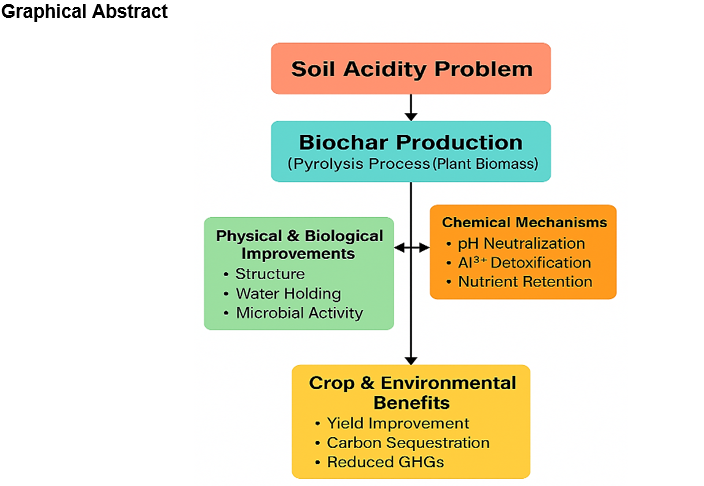
A major barrier that significantly reduces agricultural productivity on some of the world’s arable land is soil acidity. Low microbial activity, nutrient deficiencies, and, most importantly the phytotoxicity of manganese (Mn2+) and aluminum (Al3+) are common problems in these soils. For the remediation of acid soils, the use of biochar a carbon-rich substance produced by the pyrolysis of plant biomass has shown promise as a sustainable substitute for conventional liming techniques. Current studies on the various ways that biochar can balance soil acidity and improve soil qualities are summarized in this review. We examine the main chemical, physical, and biological processes that are stimulated by the high porosity and natural alkalinity of biochar. Furthermore, the review explores the scientific knowledge about the production technology, acidity problems, and mechanism of biochar in aspect of physical, chemical and biological in soil. With all the aspects this study also aims to cover the effect of biochar on crop productivity and soil fertility.
Keywords: Acid soil, aluminum toxicity, biochar, pyrolysis, soil amelioration, soil health