Microbes-assisted Biodegradation of Chlorpyrifos-an Organophosphate Pesticide and Management of Bacterial Wilt in Solanum melongena L
Shenaz Sultana Ahmed
Department of Plant Pathology, Assam Agricultural University, Jorhat-13, Assam, India.
Popy Bora *
Assam Agricultural University-Assam Rice Research Institute, Titabar, Jorhat-13, Assam, India.
*Author to whom correspondence should be addressed.
Abstract
Background: The extensive use of pesticides, particularly organophosphorus compounds like chlorpyrifos, has become an integral component of modern agriculture but has resulted in persistent residues that pose serious risks to soil health and environmental safety. Microbial biodegradation has emerged as an eco-friendly and cost-effective strategy for detoxifying pesticide-contaminated soils while supporting sustainable crop production.
Aims: The study aims to identify efficient chlorpyrifos-degrading bacteria (CDB) and evaluate their compatibility with selected microbial biocontrol agents for simultaneous degradation of chlorpyrifos residues and management of bacterial wilt of brinjal (Solanum melongena L.) caused by Ralstonia solanacearum in contaminated soil.
Study Design: Laboratory isolation and screening followed by pot culture experiment under controlled conditions.
Place and Duration of Study: The study was conducted in the Department of Plant Pathology, Assam Agricultural University, during 2022-2024.
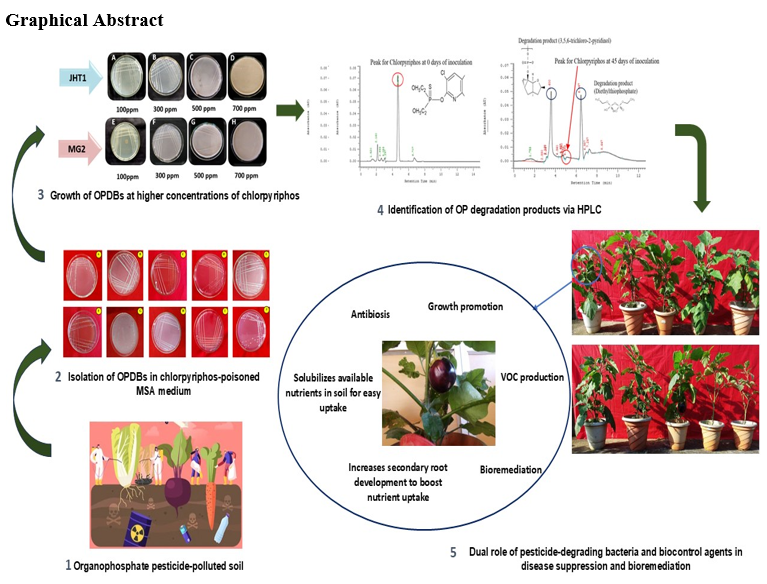
Methodology: Ten bacterial isolates capable of tolerating chlorpyrifos (25 ppm) were isolated using mineral salt medium amended with chlorpyrifos. Efficient isolates showing growth up to 700 ppm chlorpyrifos were screened for degradation efficiency. Two superior Chlorpyrifos-Degrading Bacteria (CDB), Achromobacter marplatensis JHT1 and Pseudomonas azotoformans MG2, were selected. Their in vitro compatibility was tested with each other and with two commonly used microbial biocontrol agents, viz. Pseudomonas fluorescens and Trichoderma harzianum. A compatible consortium containing the two CDBs and two MBCAs (Pseudomonas fluorescens and Trichoderma harzianum) was developed and evaluated in chlorpyrifos-contaminated soil challenged with Ralstonia solanacearum. Key parameters, including percent wilt incidence, fruit yield, and residual chlorpyrifos levels in the soil, were recorded to assess the effectiveness of the consortium.
Results: The selected isolates demonstrated growth up to 700 ppm chlorpyrifos and showed significant degradation potential under laboratory conditions. The microbial consortium comprising A. marplatensis, P. azotoformans, P. fluorescens, and T. harzianum was fully compatible in vitro. Application of the consortium in contaminated soil resulted in 80% reduction in percent wilt incidence compared to uninoculated control. Fruit yield increased 1.8-fold over the control. The consortium also significantly enhanced pesticide degradation, leading to a 71% reduction in Chlorpyrifos residues in the soil within 45 days of application, leaving only 20-28% residues. The integrated treatment performed significantly better than individual inoculations.
Conclusion: The compatible consortium of MBCA and CDB offers a promising eco-friendly strategy for residue reduction and effective management of bacterial wilt in brinjal grown in pesticide-contaminated soils, contributing to sustainable and residue-free vegetable production.
Keywords: Bacterial wilt, biodegradation, biocontrol agents, chlorpyrifos, microbial consortium, soil bioremediation